The Interview Questions That Predict Job Performance

I sat in on an interview last month where the hiring manager asked, "What's your greatest weakness?" The candidate smiled and said, "I'm a perfectionist. I just care too much about doing great work."
The hiring manager nodded approvingly and wrote something positive in his notes. I wanted to put my head on the table.
That answer told the hiring manager absolutely nothing. It's a rehearsed line that every candidate has ready. The question invited a performance, and the candidate delivered one. Nobody learned anything useful.
This is the problem with most interview questions. They test interview skills, not job skills. They reward preparation and polish, not character and capability. After 25 years of consulting on hiring, I've identified the questions that actually predict whether someone will perform on the job.
Why Standard Questions Fail
The internet has made traditional interview questions useless. Every candidate can Google "top interview questions" and practice their answers for hours. "Tell me about yourself." "Where do you see yourself in five years?" "Why should we hire you?" The answers to these questions are all scripted before the candidate walks in your door.
Scripted questions get scripted answers. And scripted answers tell you nothing about how someone will handle a real problem on a real Tuesday afternoon when everything is going wrong.
The questions that predict performance share three characteristics. They ask about specific past behavior, not hypothetical future scenarios. They require stories with details that are hard to fabricate. And they reveal character traits like accountability, problem-solving ability, and self-awareness.
The Behavioral Framework
Every question I'm about to share follows a simple principle: past behavior is the best predictor of future behavior. When you ask someone to describe a real situation they've been in, you get real information. When you ask them what they "would" do in a hypothetical, you get a performance.
The key is to listen for specifics. Good answers include names, dates, situations, actions, and outcomes. Weak answers are vague, general, and sound like they could apply to anyone. When a candidate says "I generally handle conflict by communicating openly," that's a slogan. When they say "Last March, my coworker and I disagreed about how to handle a client complaint, and here's what I did," that's evidence.
Question 1: Tell Me About a Time You Failed at Work
This is my favorite opening question because it immediately separates the self-aware candidates from the performers.
A self-aware candidate will tell you about a real failure. They'll describe what happened, take ownership of their part in it, explain what they learned, and describe how they changed their approach afterward. That sequence tells you they can handle adversity, learn from mistakes, and grow.
A performer will either deny having ever failed ("I honestly can't think of one"), reframe a success as a failure ("I worked too hard and burned myself out"), or blame someone else ("My manager set me up with unrealistic deadlines"). All three responses are red flags. Everyone has failed. The question is whether they learned from it.
Question 2: Describe a Conflict With a Coworker and How You Resolved It
Workplace conflict is inevitable. How someone handles it determines whether they'll be a positive or negative force on your team.
Listen for who they blame. A candidate who describes the conflict entirely from their perspective and positions themselves as the reasonable one is likely someone who struggles with accountability. A candidate who can articulate the other person's point of view, even while disagreeing with it, has emotional intelligence.
Also listen for the resolution. Did they address it directly, or did they avoid the conversation and hope it went away? Did they involve a manager, or did they handle it themselves? The resolution style tells you exactly how they'll handle interpersonal issues in your company.
Question 3: What Would Your Last Supervisor Say About You?
This is the setup question for the most powerful technique in my entire system. Write down the candidate's exact answer, word for word.
Later, when you do the reference check, you'll read those exact words back to the supervisor and ask, "Is that accurate?" The comparison between the candidate's self-perception and their supervisor's actual assessment is one of the most revealing data points in the entire hiring process.
But even before the reference check, the answer itself is revealing. Confident candidates give specific answers. "She'd say I was the most reliable person on the team and that I always met my deadlines." Uncertain candidates give vague ones. "I think she'd say I was a good employee." The specificity of the answer correlates directly with how well the candidate actually performed.
Question 4: Tell Me About a Time You Had to Learn Something Quickly
This question tests coachability and adaptability. In a small business, roles change fast. The person you hire for one set of responsibilities may need to take on new ones within six months. You need someone who can learn.
Strong answers describe a specific learning challenge, the steps they took to get up to speed, and the outcome. They show initiative. They asked questions. They found resources. They practiced. Weak answers are vague or focus on formal training programs that were handed to them. You want someone who learns actively, not someone who waits to be taught.
Question 5: What Questions Do You Have for Me?
This is the most underrated question in any interview. What a candidate asks you tells you what they care about and how deeply they've thought about the role.
Strong candidates ask about the team, the challenges, the expectations, and the path to success. They're evaluating you as much as you're evaluating them. That's a sign of someone who takes their career seriously and wants to make sure the fit is right on both sides.
Weak candidates either have no questions ("Nope, I think you covered everything") or only ask about compensation, time off, and when they can expect to hear back. Those are legitimate concerns, but if they're the only things a candidate wants to know, that tells you where their priorities are.
The 15-Minute Rule
Your first interview should take 15 to 20 minutes. That's it. I know that sounds short, but five focused questions with follow-ups will give you more useful information than a 60-minute conversation full of small talk and generic questions.
The goal of the first interview is to decide whether the candidate deserves a second interview. That's the only decision you're making. You're not making a hiring decision. You're making a "should I spend more time on this person" decision. Five questions. Fifteen minutes. Then move on to the next candidate.
Your Action Step
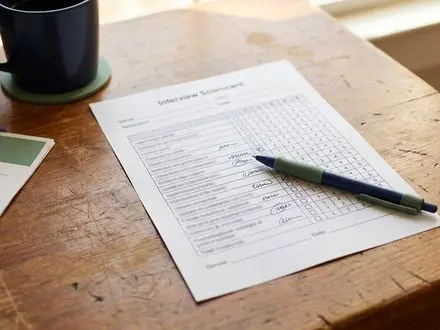
Print out these five questions and bring them to your next interview. Ask them in order. Take notes on the specific answers, not your impressions. Write down exact phrases when you hear them.
After the interview, review your notes. Did the candidate give you specific stories with real details? Or did they give you polished generalities that could apply to anyone? The specifics are where the truth lives. This is Phase 7 of the 10-phase hiring system, and these questions have helped over 500 business owners see past the performance and find the person.
These five questions are the core of Phase 7 in the 10-phase hiring system. They work because they force candidates to tell real stories with real details, not rehearsed slogans. Combined with the facility tour (Phase 6) and the second interview (Phase 8), they give you a complete picture of who the candidate actually is, not just who they claim to be.
These questions are the core of Phase 6 in the 10-phase hiring system. Pair them with the facility tour to see character in the wild, score every answer objectively, and always bring your finalist back for a second interview.
Pull a ready-made set from our interview questions tool and bring the same questions to every candidate.