The Pause Before You Hire: Your Last Line of Defense

Stop before you commit.
You've screened resumes. You've done the phone screen. You've run the interviews, the skills test, the second interview, the references. It all checks out. Your front-runner is sitting at the top of the list, the team likes them, the references came back positive, and you're reaching for the phone.
Stop.
Not because something's wrong. Because this is the most important moment in the whole process, and it deserves a deliberate pause instead of momentum carrying you over the line.
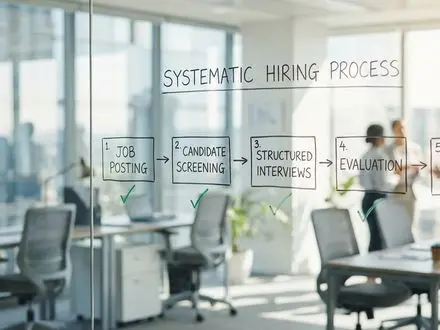
This is Phase 10 of the ten-phase hiring system. It's the last one for a reason. Everything before this was about gathering evidence. This phase is about reading that evidence cold, one last time, before you sign your name to a decision that will shape your team for years. It's the safeguard standing between you and a $17,000 mistake.
I've watched owners do all nine phases right and then blow the whole thing in the final ten minutes because they were in a hurry to be done. The pause is how you avoid being one of them.
Why the pause feels unnecessary (and why that's the trap)
Here's what's running through your head when you skip this step.
The role's been open for six weeks. You're covering the work yourself or dumping it on people who are already stretched. The front-runner looked great in the room. The references sounded fine. There's pressure to fill the seat and get back to running your business.
Every one of those feelings is real. And every one of them is exactly why shortcuts happen at the finish line. You're tired, you're relieved, and relief makes you generous. You start rounding up. The candidate who was a 7 becomes an 8 in your memory because you want them to be.
The pause exists to interrupt that. Treat it as a process with a clear start and end, run in one sitting, with fresh eyes, before the offer goes out. Running it is the opposite of stalling. It costs you thirty minutes. A bad hire costs you months.
Step 1: Review everything in one sitting
Block thirty minutes. Close the door. Put your phone in a drawer.
Now lay out every artifact you've collected on this candidate:
The resume and application
Your phone-screen notes
Anything you observed during the tour or the walk-around
Your first interview notes
Your second interview notes
The skills test or work sample results
Your reference call notes
Read them in order, start to finish, the way the candidate actually moved through your process. Not skimming. Reading.
The reason you do this in one sitting is that memory is unreliable and scattered. When you reviewed the second interview, you didn't have the phone screen in front of you. When you made the reference calls, the skills test was three days old. Each piece felt fine on its own. The pause is the first time all the pieces sit on the same table at the same time.
Step 2: Check for consistency across every touchpoint
This is where the value lives. You're not re-evaluating whether the candidate is good. You already decided that. You're checking whether the story holds together across every point of contact.
Ask yourself:
Did they tell the same version of why they left their last job in the phone screen and the second interview?
Did the references describe the same person you interviewed, or a different one?
Did the skills test confirm what they claimed about their experience, or quietly contradict it?
Were they consistent in tone and attitude across both interviews, or did they show you one face early and another face later?
Small inconsistencies are the tells. A candidate who's managing an impression slips when they have to keep the story straight across weeks and multiple conversations. A candidate who's just being honest doesn't have to manage anything, so they stay consistent without trying.
If you ran your reference calls and your second interview properly, you'll have enough material to actually do this check. If a touchpoint feels thin, that's information too. It might mean you have a gap you should close before you commit.
Step 3: The gut-check
After you've read everything, sit with one question: would you bet your own money on this person?
Not "are they qualified." Not "did they interview well." Would you put your own cash on the line that this hire works out twelve months from now?
Your gut is pattern recognition built from years of running your business. There's nothing magic about it. When something feels off after a clean process, that feeling is usually your subconscious flagging a pattern your conscious mind hasn't named yet. Don't ignore it, and don't let it run the show either. Use it as a pointer. If your gut says no, go back and find out what it's reacting to. Usually it's pointing at something real in the notes you just read.
The mistake is treating the gut-check as the whole decision. It earns its place only because you did nine phases of structured work first. Instinct without evidence is just a guess. Instinct on top of evidence is judgment.
Step 4: Re-examine the red flags you talked yourself out of
Every candidate has at least one thing that gave you pause earlier. The gap on the resume. The reference who was a little too careful with their words. The answer in the second interview that didn't quite land. The salary number that seems high for the role.
During the process, you probably set those aside so you could keep moving. That was the right call then. Now is the time to pull them back out.
Make a short list of every concern you had at any point, even the ones you decided were nothing. Look at each one with the full picture in front of you. Some of them will dissolve, because now you have context you didn't have when the concern first showed up. Some of them won't. The ones that survive a second look are the ones you need to resolve before the offer goes out, not after.
If a red flag is serious enough that you can't resolve it from your notes, you make one more call. You ask one more question. You do not paper over it because you're tired of looking.
Step 5: Write down the offer terms before you say them out loud
Before you pick up the phone, put the offer in writing for yourself. Not the formal offer letter yet. Your own clear version of what you're about to propose:
The exact title and who this person reports to
The base pay, and any variable or bonus structure
The start date you want
The benefits and the waiting periods
Anything that's negotiable and anything that isn't
Owners get into trouble when they wing the offer conversation. They name a number off the top of their head, the candidate counters, and they cave on the spot because they don't have a line in their mind. Writing it down first gives you that line. You know your ceiling before the conversation starts, so you're negotiating from a plan instead of from pressure.
This is also where you catch the things that are easy to forget. The start date that collides with your busy season. The title that's going to cause friction with someone already on the team. Better to find that now, on paper, than in week one.
Step 6: Plan the first 30, 60, and 90 days
Here's the step almost everyone skips, and it's the one that separates a hire that sticks from a hire that quits in month three.
Before you make the offer, sketch out what the first ninety days actually look like for this person:
First 30 days: Who trains them? What do they need to learn before they can do anything on their own? What does week one look like, hour by hour, on day one?
First 60 days: What should they be handling without supervision by now? What's the first real test of whether they can do the job?
First 90 days: What does "this is working" look like? What's the standard they need to hit to confirm you made the right call?
You do this before the offer for two reasons. First, it forces you to confirm you're actually ready to bring someone on. If you can't describe their first thirty days, you're not ready to hire, and the offer is premature. Second, planning the onboarding before you commit sometimes surfaces a doubt you didn't know you had.
A great candidate dropped into a chaotic, unplanned first month will look like a bad hire by day sixty. The pause is your chance to make sure you're not setting up a good person to fail.
Then make the call
Once you've done all six steps and the candidate still holds up, stop second-guessing and move. The pause is a single, disciplined review with a clear end. It buys you one careful look, never permission to stall forever. When it's done and the answer is yes, you make the offer with confidence, because you've earned that confidence with evidence instead of hope.
If the answer is no, you've just saved yourself the most expensive mistake in small business. You go back to your shortlist or you reopen the search. Either of those beats firing someone in ninety days and starting over from zero.
How this threads back to the system
Phase 10 only works because of the nine phases in front of it. The pause has nothing to review if you didn't gather real evidence along the way. A structured phone screen, two real interviews, a skills test, honest reference calls, all of it feeds the table you lay everything out on in this final step. Skip the work earlier and the pause becomes thirty minutes of staring at thin notes, which protects no one.
That's the whole point of running a real system instead of hiring on instinct. Each phase builds the evidence the next one depends on, and the last phase is where it all gets read together before you commit. It's the same discipline I lay out in The Naked Interview: slow down at the exact moment everyone else speeds up, because that's where the costly mistakes get made.
Run the pause every time. Make it a non-negotiable part of how you hire, the same way you'd never sign a contract without reading it twice.
Ready to put the whole system in place? Grab the hiring checklist and walk every hire through all ten phases, from the first resume to the final pause, so nothing slips through when you're tired and the seat's been empty too long.